6 6 6 6 6 6
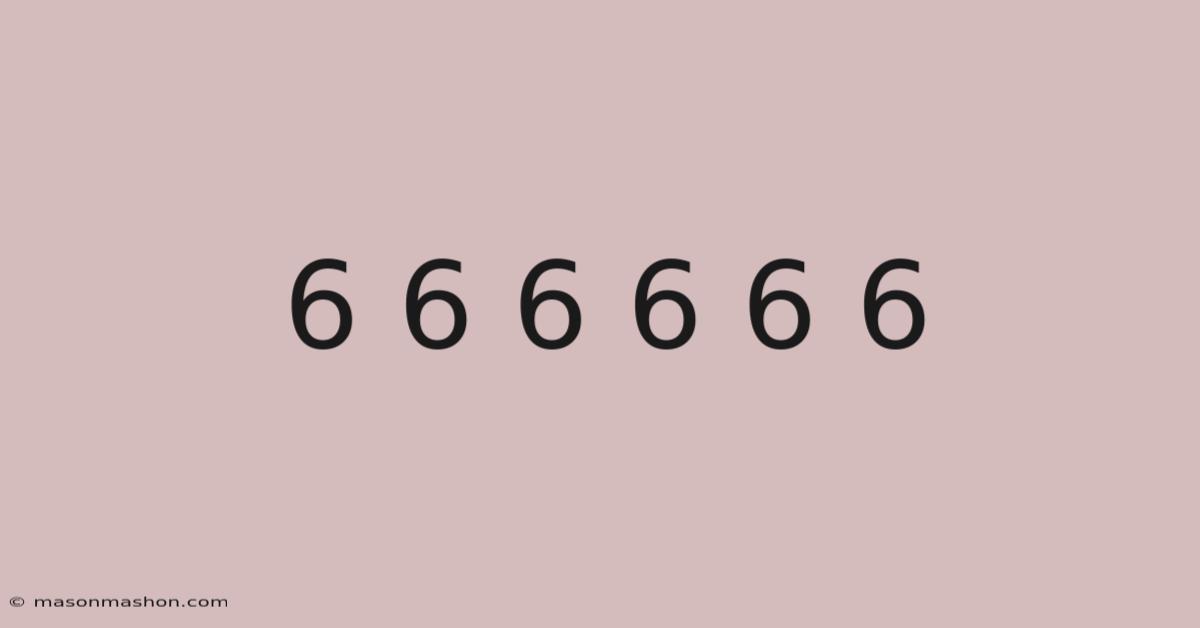
The number stared back from the receipt. $66.66. The cashier didn't blink. Consider this: i stood there, card in hand, feeling that familiar prickle — the one that says pay attention, this means something*. Now, it doesn't, of course. Day to day, it's just a price. Two items, tax included, pure coincidence. But the brain doesn't care about coincidence. The brain cares about patterns. And six-six-six-six-six-six? That's a pattern that has haunted human imagination for roughly two thousand years.
What Is 666,666 — And Why Does It Feel Different?
Six hundred sixty-six thousand, six hundred sixty-six. Worth adding: written as digits — 666,666 — it's a visual echo. Written out, it's a mouthful. Worth adding: the number of the beast, repeated. Doubled. Amplified.
Mathematically, it's just an integer. Even. Divisible by 2, 3, 6, 7, 13, 14, 21, 26, 37, 39, 42, 74, 78, 91, 111, 182, 222, 259, 273, 333, 518, 546, 666, 777, 1001, 1554, 2002, 2331, 3003, 4662, 6006, 6993, 13986, 20979, 41958, 111111, 222222, 333333, and itself. It's a repdigit in base 10 — all sixes. That's the technical term: repdigit*. Numbers composed of a single repeated digit. 11, 222, 7777, 666666.
But nobody loses sleep over repdigits. They lose sleep over what 666 represents*.
The origin is Revelation 13:18. But 666 won. The earliest known fragment — Papyrus 115, third century — reads 616. Also, " Or 616, depending on your manuscript. "Let the one who has understanding calculate the number of the beast, for it is the number of a man, and his number is 666.History, theology, and pop culture all voted for 666.
So what happens when you stack it? 666,666 isn't in scripture. It's a human construction. That's why a cultural mutation. In real terms, the number of the beast, times 1,001. On top of that, (Literally: 666 × 1,001 = 666,666. And 1,001 = 7 × 11 × 13. Make of that what you will.
Why This Number Gets Under Your Skin
Here's the thing about pattern recognition: it's not a bug. Because of that, could be tiger. Rustle in the grass? Practically speaking, the ones who assumed tiger survived. Could be wind. It's the feature that kept your ancestors alive. The ones who calculated probabilities got eaten.
We're descended from the tiger-assumers. Which means our brains over-detect* pattern and agency. Faces in toast. Day to day, voices in static. Meaning in randomness. This is pareidolia* — seeing patterns where none exist — and apophenia* — perceiving connections between unrelated things. They're not flaws. They're survival mechanisms running on hardware that hasn't had a firmware update in 200,000 years.
666,666 hits both systems. Practically speaking, visual pattern: six identical digits. Which means semantic pattern: the cultural meaning of 666, amplified. Your brain screams signal!* even though the noise floor is exactly where it should be.
And culture reinforces it. The Omen* (1976). Iron Maiden's "The Number of the Beast." Countless horror novels, metal albums, internet creepypastas. The number becomes a meme in the Dawkins sense — a self-replicating unit of culture. Because of that, each repetition strengthens the association. By the time you see 666,666 on a receipt, or a license plate, or a timestamp (6:66 doesn't exist, but 6:66 PM would be 7:06 PM — close enough for the pattern-hungry mind), the pathway is paved.
The Mathematics of Coincidence
Let's ground this. Times. Serial numbers. Step counts. That's why prices. Phone numbers. Because of that, in any given day, you encounter thousands of numbers. Odometer readings. Addresses. The probability of not seeing a striking pattern is near zero.
Birthday paradox logic applies. With 365 days and 23 people, there's a 50% chance of a shared birthday. With thousands of daily number encounters and a handful of "meaningful" patterns (666, 777, 1111, 1234, 420, 69, your birthday, your anniversary), collisions are inevitable.
But "inevitable" doesn't feel like "random." It feels like synchronicity*. That said, jung's term. Still, meaningful coincidence. The universe winking. And maybe it is. But maybe it's also just statistics wearing a trench coat.
How the Number Shows Up in Real Life
You'll find 666,666 in surprising places if you look. Or if you don't look — it finds you.
Finance. A stock hits $666.66. A crypto wallet shows 666,666 tokens. A portfolio value lands there for exactly one refresh. Traders screenshot it. Reddit threads bloom. Someone always says "sell now" and someone always says "buy more." The number becomes a Rorschach test for market sentiment.
Gaming. Steam IDs. Xbox gamertags. Discord discriminators (RIP). Speedrun times. High scores. 666,666 points in Pinball* or Tetris* or Cookie Clicker* — it's a milestone achievement precisely because* of the cultural weight. Players aim for it. That's the twist: the pattern becomes a target, and the targeting makes the pattern appear more often. Observer effect, cultural edition.
Continue exploring with our guides on what is a 44 out of 50 and what day is it in 14 days.
Continue exploring with our guides on what is a 44 out of 50 and what day is it in 14 days.
Dates. June 6, 2006 (06/06/06). June 6, 2066 (06/06/66). People got married. People gave birth. People hid in bunkers. The 2006 date spawned a remake of The Omen*, a Slayer tour, and approximately 14,000 think pieces. Nothing happened. The world didn't end. But the anticipation* was real — measurable in search trends, church attendance, horror movie ticket sales.
Science. The asteroid 666666 doesn't exist (highest numbered is in the 600,000s as of writing). But there's a minor planet 666 Desdemona. And 6666 Frö. The numbering is sequential by discovery. No demonic committee assigns them.
Pop culture. Search "
Pop culture. Search results for "666,666" yield a strange mix of numerology blogs, Reddit deep-dives, and YouTube videos with titles like "This Number Will SHOCK You" (it won't). The number appears in movies as a subtle background detail — a price tag, a room number, a license plate. Sometimes it's intentional. Sometimes it's coincidence. But once you've noticed it once, your brain starts flagging every near-miss. 777 becomes 666-adjacent. 6666 becomes a quadruple emphasis. The pattern expands to fill the available data.
The Feedback Loop
Here's where it gets recursive. On the flip side, the red cars were always there. It's like buying a red car and suddenly seeing red cars on every block. Because of that, you start seeing it everywhere — not because it's appearing more, but because your attention has tuned to that frequency. The more you notice 666,666, the more you expect* to notice it. But now you're looking.
This creates a feedback loop:
-
-
- Significance confirmed. Also, you subconsciously scan for it. You find it (or something close). Because of that, you notice 666,666 once (or read about it). 3. 2. Which means your brain marks it as significant. Loop intensifies.
-
Social media amplifies this. That said, one person posts a screenshot. Practically speaking, others share their own. Think about it: a collective pattern emerges — not in reality, but in the shared narrative. The meme becomes realer than the reality.
The Banality of Evil Numbers
What's fascinating is how mundane 666,666 actually is. And the sacred and the trivial collapse into each other. On top of that, a score in a mobile game. It's a number on a receipt. A timestamp that doesn't technically exist. The divine wink and the grocery store total are indistinguishable.
At its core, the real power of the meme — not that it's supernatural, but that it transforms the ordinary into the meaningful. Also, every number becomes a potential sign. Every coincidence becomes a message. The world becomes a text waiting to be decoded.
But here's the thing: maybe that's not a bug. Maybe it's a feature.
Humans are meaning-making machines. Even so, it kept our ancestors alive — better to mistake a rustling leaf for a predator than miss a real threat. We evolved to see patterns in chaos, to find signals in noise, to turn random events into coherent stories. The same mechanism that makes us see faces in clouds makes us see significance in numbers.
The question isn't whether 666,666 is "real." It's why we need it to be.
Conclusion
666,666 is a cultural virus that hijacked our pattern-recognition software and turned it into a game. On top of that, it's memetic evolution in action — a self-replicating idea that mutates as it spreads, adapting to each new host and context. Whether it's a divine message, statistical inevitability, or collective hallucination depends entirely on what story you prefer to believe.
But perhaps the most interesting thing about 666,666 isn't what it means — it's what it reveals about us. In our desperate search for patterns, in our need to find meaning in the meaningless, in our willingness to see the universe winking back at us from every receipt and scoreboard — we discover something profound about the human condition.
We are creatures who turn numbers into narratives, coincidence into conspiracy, and chance into choice. 666,666 is just the latest example of a very old habit: the relentless, beautiful, sometimes terrifying human project of making meaning from nothing at all.
Latest Posts
Related Posts
Readers Also Enjoyed
-
To Pour Water On Calcium Oxide
Jul 30, 2026
-
150 Km Per Hour In Miles
Jul 30, 2026
-
150 Kilometers Per Hour To Miles
Jul 30, 2026
-
How Many Thousands Are In A Million
Jul 30, 2026
-
How Many Years Is 1000 Days
Jul 30, 2026
