The Difference Of 17 And 5 Times A Number
What Does "the Difference of 17 and 5 Times a Number" Actually Mean?
You see it on a worksheet, a test, maybe a coding challenge — "the difference of 17 and 5 times a number." It sounds like something you'd nod along to in class and then forget five minutes later. But here's the thing: this phrase is a doorway into a skill that shows up everywhere, from basic algebra to real-world problem solving. And most people never really stop to ask what it's actually asking them to do.
So let's slow down and break it apart. Not because it's impossibly hard, but because getting it right matters more than most math content gives it credit for.
What Is the Difference of 17 and 5 Times a Number?
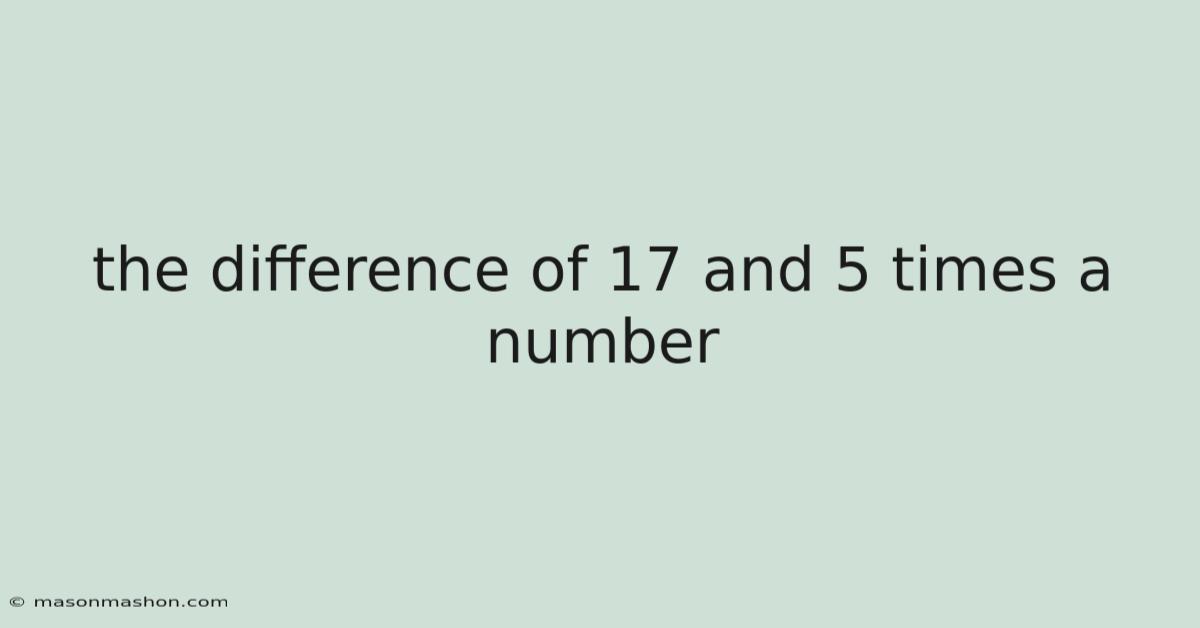
At its core, this phrase is describing an algebraic expression. It's a way of turning English words into math symbols — a translation job. The phrase asks you to take the number 17 and subtract from it the result of multiplying 5 by some unknown number.
That unknown number is what mathematicians call a variable, usually written as x or n. So "5 times a number" becomes 5x (or 5n). And "the difference of 17 and that" means you subtract the second part from the first. Which is the point.
The expression looks like this:
17 − 5x
That's it. That's the whole thing. But the simplicity of the final form hides a lot of nuance in how you get there, and that's where most confusion lives.
Why This Expression Shows Up More Than You Think
You might wonder why a simple subtraction-and-multiplication phrase deserves an entire blog post. The reason is that this kind of verbal-to-mathematical translation is foundational. It's the bridge between everyday language and the formal math that powers everything from spreadsheet formulas to physics equations.
Think about it. When you're budgeting and you say, "I started with 17 dollars and I spent 5 dollars for each item I bought," you're describing the exact same structure. The number of items is your variable. The amount left is 17 minus 5 times that number.
Or consider a scenario where you're calculating a remaining balance after a fixed charge and a variable one. The pattern repeats. Once you can recognize it, you stop seeing it as a math problem and start seeing it as a thinking tool.
How to Translate the Phrase Step by Step
Identify the Key Words
The phrase has three critical pieces: "difference," "17," and "5 times a number." Each one maps to a specific math operation.
- Difference signals subtraction. In math, "difference" always means one quantity minus another.
- 17 is the first quantity — the one that comes first in the phrase.
- 5 times a number is the second quantity — the one being subtracted.
Pay Attention to Order
This is the part most people gloss over. "The difference of A and B" means A − B, not B − A. The word order matters. If the phrase were "the difference of 5 times a number and 17," it would flip to 5x − 17. Same words, different result.
Write the Expression
Once you've identified the parts and the order, you combine them:
17 − 5x
That's the complete algebraic expression. No addition, no multiplication sign needed — the juxtaposition of 5 and x implies multiplication in standard algebraic notation.
Evaluating the Expression for Specific Values
Plugging In a Number
Once you have 17 − 5x, you can find the value for any specific number. If x equals 2, you calculate 17 − 5(2), which is 17 − 10, giving you 7. If x equals 3, you get 17 − 15, which is 2.
The process is straightforward, but the habit of substituting carefully matters. A lot of errors come from rushing through the multiplication before the subtraction — and while order of operations handles that for you, understanding why you multiply first builds a stronger intuition.
If you found this helpful, you might also enjoy identify the two key factors that determine nuclear stability or 120 hrs is how many days.
If you found this helpful, you might also enjoy identify the two key factors that determine nuclear stability or 120 hrs is how many days.
If you found this helpful, you might also enjoy identify the two key factors that determine nuclear stability or 120 hrs is how many days.
What Happens When the Result Is Negative?
Here's a moment that trips people up. Plus, in real-world terms, this might mean you've overspent your budget or gone past a threshold. If x equals 4, you get 17 − 20, which is −3. That's not a mistake. But the expression is perfectly valid for values of x that make 5x larger than 17. Negative results carry meaning — they're not errors waiting to be fixed.
Working Backward: Finding the Number When You Know the Result
Sometimes you're given the expression and the answer, and you need to find the unknown. Consider this: say you know that 17 − 5x equals 2. How do you find x?
You set up the equation:
17 − 5x = 2
Then solve step by step. Subtract 17 from both sides to get −5x = −15. Divide both sides by −5, and you find that x = 3.
This reverse-engineering skill is incredibly useful. It's the basis for solving equations in every branch of math and science, and it starts with understanding how expressions like this one are built.
Common Mistakes / What Most People Get Wrong
Reversing the Order
The single most common error is flipping the subtraction. People read "difference of 17 and 5 times a number" and write 5x − 17 instead of 17 − 5x. The word "difference" doesn't tell you which quantity is larger — it just tells you the operation. The order comes from the phrasing: "the difference of [first thing] and [second thing]" means first minus second.
Confusing "Difference" with "Sum"
Some learners mix up "difference" (subtraction) with "sum" (addition) or "product" (multiplication). This sounds basic, but in timed test situations or when reading quickly, the wrong keyword can stick. Slowing down to label each part of the phrase before writing anything down helps a lot.
Forgetting That "Times a Number" Is One Unit
Another mistake is treating "5 times a number" as two separate things instead of a single expression. People sometimes write 17 − 5 x, with a space that makes it look like three disconnected pieces. Recognizing that 5x is one term — one chunk — keeps the expression
intact and prevents you from accidentally subtracting 5 from 17 before multiplying by $x$.
Mismanaging the Negative Sign
When the expression contains a subtraction sign followed by a variable, students often lose track of the sign during algebraic manipulation. That said, for instance, if you are solving $17 - 5x = 20$, it is easy to accidentally treat the $5x$ as a positive $5x$ during the movement across the equals sign. Always remember that the minus sign is attached to the term; it is not just a separator between numbers, but a part of the $5x$ itself.
Summary and Final Tips
Mastering algebraic expressions is less about memorizing formulas and more about developing a precise "translation" skill. You are essentially translating a language of words into a language of symbols. To improve your accuracy, keep these three habits in mind:
- Read Twice, Write Once: Before putting pen to paper, identify the "anchor" number (the starting value) and the "modifier" (the part being subtracted or added).
- Use Parentheses for Safety: When substituting negative numbers into an expression, always wrap them in parentheses. Here's one way to look at it: if $x = -2$, write $17 - 5(-2)$ to ensure you don't lose the double negative.
- Check Your Work: Once you find a value for $x$, plug it back into the original word problem. If the math holds up, your translation was successful.
Conclusion
Algebraic expressions like $17 - 5x$ serve as the building blocks for more complex mathematical reasoning. While they may seem simple at first glance, they require a disciplined approach to order of operations, sign management, and linguistic interpretation. By understanding how to move forward through substitution and backward through equation solving, you gain more than just the ability to find $x$—you gain the ability to model the logic of the world around you.
Latest Posts
Related Posts
More of the Same
-
To Pour Water On Calcium Oxide
Jul 30, 2026
-
150 Km Per Hour In Miles
Jul 30, 2026
-
150 Kilometers Per Hour To Miles
Jul 30, 2026
-
How Many Thousands Are In A Million
Jul 30, 2026
-
How Many Years Is 1000 Days
Jul 30, 2026
